2026 Scans Reveal the Hidden Nerve Stranglehold Behind Chronic Migraines — And Why Big Pharma Has Been Treating the Wrong Organ for 40 Years
Over 100,000 men and women are finally ending decades of dark rooms, vomit-inducing triptans, and ER visits — after groundbreaking scans revealed the physical tissue clamp standard brain MRIs missed completely.


High-resolution elastography imaging comparing cervical fascia states: supple, water-rich tissue with effortless nerve glide (left) versus hardened, densified fascia physically clamping down on occipital nerve roots in a chronic migraine sufferer (right).
Before I tell you about the breakthrough scans that are changing headache medicine forever, I have to tell you why I walked away from hospital neurology.
My younger sister had chronic migraines. She had her first attack at twenty-four, and for the next twenty-two years, her life was stolen from her.
She spent holidays locked inside pitch-black bedrooms with frozen washcloths pressed against her skull. She vomited into bathroom wastebaskets from the sheer agony of the pain. She missed her children’s birthdays, had to give up her teaching job, and lived in constant, terrifying fear of the next attack.
I went into medicine because of her. I chose neurology because I believed it held the answers.
I didn't have to be in practice very long to realize that most of the neurologists I worked alongside had quietly given up on these patients.
In the hospital workrooms, there was a whole vocabulary for migraine sufferers behind closed doors:
It was in the deep sigh when a migraine name appeared on the afternoon schedule. It was in how fast the doctor closed her chart. It was in the ten-minute cap they slapped on the appointment before they ever stepped into the room.
And their only answer was always the exact same prescription shelf: Sumatriptan, Rizatriptan, Topamax, beta-blockers, and eventually $1,200 rounds of Botox injections.
Every single month, those exact same patients sat back in our chairs saying the same thing:
"It knocked me out for four hours. It made my chest feel tight and my brain foggy. And the rebound headache the next day was twice as bad."
The medications didn't cure them. They just drugged their central nervous system while the underlying problem raged on.
And year after year, their brain MRIs came back 100% normal.
That was the giant clue my entire profession was missing: Their brains were not broken. We were simply looking at the wrong organ.
What the 2026 Scans Finally Revealed
Over the past two years, specialized pain researchers stopped staring at the brain and pointed new high-resolution ultrasound elastography scans at the tissue wrapping the back of the head and neck: Fascia.

Anatomical diagram: Suboccipital fascia physically tethers to the brain's dura mater and clamps the greater occipital nerve roots, referring intense pain into temples and eyes.
What came back on the scans shocked the medical community:
In chronic migraine sufferers, the connective tissue layer at the base of the skull was on average 72% to 76% denser, thicker, and stiffer than in healthy people.
Think about what that means.
Right at the base of your skull, where your neck meets your head, major sensory nerves—including the Greater Occipital Nerve—must pass through tight tunnels in this neck fascia.
When that tissue dries out, it doesn't just get tight. It shrinks like shrink-wrap. It turns into a hard, leathery vice that physically strangles those nerve roots 24 hours a day, 7 days a week.
It is like stepping on a garden hose with a heavy boot.
And here is why you feel the pain in your temples and behind your eyes: Those crushed neck nerves plug straight into the Trigeminocervical Complex—the identical brainstem switchboard that controls the front of your face and forehead!
The mechanical stranglehold in your neck sends constant alarm signals into your head. That is what causes the throbbing behind your eyes, the vice-grip around your temples, and the sickness in your stomach.
Your migraines are not an incurable brain chemical disease. They are a physical, mechanical nerve stranglehold.
The Suboccipital Myodural Bridge & Occipital Nerve Entrapment
Landmark anatomical dissections have confirmed that suboccipital neck fascia physically tethers directly to the pain-sensitive cranial dura mater through the myodural bridge. In clinical surgical decompression trials, physically un-clamping the dense fascial bands constricting the occipital nerves permanently eliminated or slashed migraines in up to 88% of patients.
The Collagen Architecture: Why Fascia Turns into a Shrink-Wrap Clamp
To understand why your neck and skull fascia turned into rigid rawhide, you have to look at what it is actually made of:

Microscopic comparison: Dehydrated collagen fibers tangled like dry felt (left) versus supple, wavy collagen floating in lubricating hyaluronic acid fluid (right).
Fascia is an intricate 3D web of Type I and Type III collagen fibers suspended in a lubricating fluid made of Hyaluronic Acid (HA).
In a healthy body, this collagen web is springy and wavy. Hyaluronic acid acts like millions of microscopic water magnets, pulling water in to create a slippery "glide layer." Your muscles and nerves slide effortlessly without friction.
But as we age, look down at phones and computers ("tech neck"), and experience stress, two catastrophic breakdowns happen:
- Collagen Fibers Stiffen & Tangled: Without essential building cofactors (silica, vitamin C, zinc), collagen fibers dry out and cross-link abnormally, stiffening like old rawhide.
- Hyaluronic Acid Turns to Sticky Molasses: Groundbreaking research by Dr. Carla Stecco showed that when fascia loses water, hyaluronic acid clumps together. It becomes 500% thicker and turns into sticky glue.
The silky glide layer vanishes. The hardened collagen web shrinks down and clamps your occipital nerves in an unforgiving vice grip.
Hyaluronan Aggregation & Mechanical Nerve Irritation
Studies in connective tissue bioengineering prove that when fascia dehydrates, hyaluronic acid molecules aggregate into dense, tangled chains. Viscosity spikes up to fivefold, destroying tissue slide and creating severe mechanical shear stress on embedded pain nerves.
The Kitchen Sponge Truth: Why Drinking Water & Collagen Powder Fails
At this point, patients always ask me: "Dr. Vence, if my fascia is dehydrated, why doesn't drinking 8 glasses of water cure my migraines?"

The Kitchen Sponge Test: Water poured on a dry, hardened sponge rolls straight off (left). Only when the internal porous matrix is restored does it hold fluid (right).
Think about a kitchen sponge left on your sink for two weeks. It turns rock-hard, shriveled, and crusty.
If you take a glass of water and dump it over that dry sponge, what happens? The water beads right up and rolls off the hard crust onto the counter. The inside of the sponge stays completely stiff and dry.
The sponge didn't fail because it lacked water. It failed because it lost the internal structure that lets it hold water!
Your fascia works the exact same way. Drinking gallons of water does nothing because your dry collagen scaffolding has lost the Hyaluronic Acid and Bamboo Silica holding-scaffolding needed to trap that water inside deep tissue. The water just goes straight to your bladder, while your neck fascia stays bone-dry and clamped tight around your nerves.
And dumping generic collagen powder into your morning coffee doesn't fix it either. Taking collagen without the specific cofactors (Silica, Vitamin C, Zinc, Manganese) is like dumping bags of dry cement onto a job site with no water or mixer—it forms hard, dense clumps. To build supple, gliding fascia, your cells need the complete nutrient matrix working together.
The Second Missing Piece: Your Broken "Pain Brake" (PEA)
Even after you understand the physical clamp, there is a chemical reason why your migraines feel so violent and explosive:

Molecular 3D visualization: Micronized PEA binds to nerve receptors, extinguishing the fiery red neurogenic inflammatory storm and stopping CGRP release.
Your body produces a natural, built-in emergency molecule called Palmitoylethanolamide (PEA). Its sole biological job is to act as your nervous system's "pain brake." When nerves get pinched, PEA quiets irritated cells and shuts off inflammation.
Here is the cruel catch researchers discovered:
After months or years of constant pressure from tight neck fascia, your body burns through PEA faster than it can replace it. Your natural pain brake is completely exhausted.
Without PEA, the "inflammation switch" on your cranial nerves gets stuck in the "ON" position 24/7. Your nerves stay trapped on hair-trigger alert.
Even tiny triggers—a sudden weather change, glare from a computer screen, a whiff of strong perfume, or a poor night of sleep—cause your nerves to detonate a blinding migraine storm because there is no PEA left to stop the alarm.
Clinical Double-Blind Evidence on PEA Replenishment
Systematic reviews of double-blind randomized controlled trials confirm that oral administration of micronized PEA dramatically extinguishes neurogenic inflammation, reduces clinical pain intensity by nearly 2 full visual scale points, and slashes chronic migraine frequency without a single reported side effect.
The Dual-Action Solution: Un-Clamp the Tissue, Silence the Alarm
Once you understand the science, the path to real freedom becomes crystal clear. You have to do two things at the exact same time:
Deliver clinical-grade Hyaluronic Acid, Bamboo Silica, and collagen cofactors to deep connective tissue to break up sticky densification and un-clamp the vice around your cranial nerves.
Flood starved nerve roots with clinical micronized PEA and Boswellia to shut off neurogenic inflammation, close the P2X7 switch, and quiet screaming nerves at the source.
For years, my patients had to order 6 different raw bulk powders from compounding pharmacies.
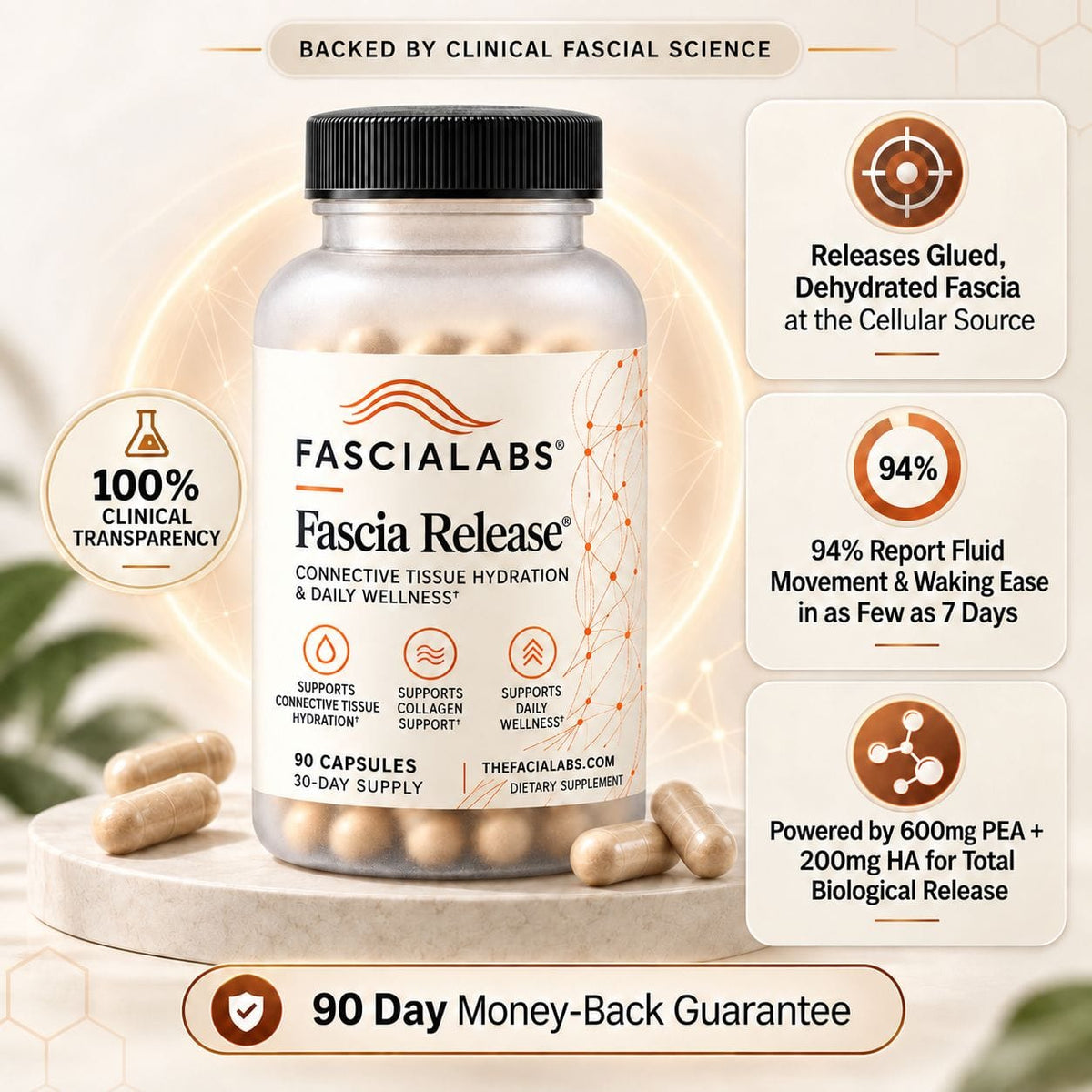
That all changed when an American biomedical laboratory combined the exact clinical doses into a single daily formula: Fascia Release® by FasciaLabs.
FasciaLabs® Fascia Release®
Deep Tissue Hydration & Cranial Nerve Mobility Formula
"Fascia Release is the single most important tool I recommend to chronic headache and migraine patients before ever considering heavy pharmaceuticals. By un-clamping the suboccipital fascia and replenishing PEA, it addresses the true mechanical root cause that medicine ignored for decades."

412 clinicians, including neurologists and physical therapists, recommend Fascia Release. Learn more
All 9 Clinical Nutrients per Daily Serving (Explained Simply):
What Over 100,000 Customers Experience:
Select Your Supply of Fascia Release®
Every order backed by our ironclad 90-Day 100% Money-Back Guarantee

Real Sufferers. Documented Life Transformations.

"The vice grip at the base of my skull finally let go."
"I lived in terror of bright lights and weather changes for over twenty years. I was taking Maxalt three times a week and my stomach was wrecked from ibuprofen. Within two weeks of taking Fascia Release, I felt the tight knot at the base of my skull literally soften. I haven't taken a prescription pill in 45 days. My husband says I look like a totally different person."

"Doctors told me it was 'work stress.' This did what Botox couldn't."
"My neurologist had me on quarterly Botox injections that cost a fortune and made my neck feel paralyzed. The headaches always returned. When I read about the fascia clamp, everything clicked. Three weeks into Fascia Release, the constant temple throbbing disappeared. This is the real deal."

"I cried the first weekend I didn't lose to a dark room."
"Nothing is more heartbreaking than telling your kids Mommy can't play because she has to lie in a dark room with an ice pack. Fascia Release gave me my life back. I wake up with zero neck tension and haven't had a single blinding migraine since week three."

"As a medical professional, I was skeptical. The science is 100% real."
"I spent 35 years in medicine and know how rare real breakthroughs are. But the clinical research on PEA and fascia rehydration is undeniable. I went from 14 migraine days a month down to just one mild headache in the past two months. Remarkable formula."

"The sponge analogy was spot on. Water never worked—this did."
"Staring at screens 10 hours a day used to trigger violent ocular migraines every Thursday. I drank gallons of water and it changed nothing. Fascia Release fixed the underlying tissue clamp. I haven't had a visual aura or temple pounding in nearly two months."

"No more rebound headaches from triptans!"
"I was trapped in the medication overuse cycle. Every triptan gave me another headache 24 hours later. Fascia Release broke that cycle in 10 days. My neck glides freely for the first time since my thirties. Thank you Dr. Vence!"
Frequently Asked Questions
Can I take Fascia Release® while taking my prescribed triptans or preventative medications?
Yes. Fascia Release® is a 100% natural, non-drowsy nutrient and fatty acid formula that works peripherally on connective tissue hydration and cellular lipid signaling, without interfering with central nervous system drugs. As always, consult your physician.
Why didn't physical therapy, chiropractic, or massage fix this on its own?
Physical therapy and massage tools attempt to force dehydrated, densified fascia to stretch mechanically. But pulling on brittle, dry collagen is like pulling on dried rawhide—it can cause microscopic tearing and reflex spasms. You must rehydrate the collagen-hyaluronan matrix from within before manual release can hold.
How is this different from ordinary collagen powders or joint supplements?
Joint supplements contain cheap glucosamine or un-targeted collagen peptides that do not reach the cranial fascial matrix and lack the water-binding cofactors. Fascia Release® contains clinical-dose 200 mg Hyaluronic Acid, 70% Bamboo Silica, and 600 mg micronized PEA—the exact triad required to un-clamp the occipital nerve.
How fast will I experience relief?
Most sufferers experience noticeable softening of neck tightness and calmer nerve reactivity within 7 to 14 days, with profound reductions in migraine frequency taking place between weeks 3 and 6 as collagen remodeling takes hold.