

If you are currently sitting at your desk, sub-consciously digging your knuckles into that agonizing, burning lump between your shoulder blade and your spine... stop for just three minutes and read this.
You know that knot all too well.
It feels like a hard marble or a twisted steel wire trapped deep inside your back. It aches when you drive. It burns when you type. And by 4:00 PM every single afternoon, it sends shooting, throbbing tension headaches straight up the side of your neck and behind your eyes.
You've probably tried everything to kill it:
- Leaning against doorframes with hard lacrosse balls or tennis balls.
- Spending $120 a week on deep tissue massages that leave you bruised for days.
- Painful trigger point dry needling sessions with long steel needles.
- Theraguns, vibrating massage hooks, and muscle relaxant pills.
And yet, within 48 to 72 hours, the exact same burning knot locks right back up.
Here is the blunt truth modern medicine only recently uncovered: that knot is not a muscle spasm. And digging into it is biologically backwards.
The 2026 NIH Breakthrough: Inside the "Toxic Soup" of a Trigger Point
In landmark research conducted at the National Institutes of Health (NIH), clinical researchers led by Dr. Jay P. Shah did something no one had ever done before:
They inserted microscopic analytical sensors directly inside active human trigger points to measure their real-time biochemical environment.
What they discovered shocked the medical community:
- Severe Tissue Acidosis: While healthy muscle tissue maintains a neutral pH of 7.4, active trigger points exhibited a caustic, acidic pH below 5.0—as acidic as black coffee!
- The "Toxic Soup": The knot was literally floating in a cocktail of inflammatory pain peptides: Substance P, CGRP, Bradykinin, and Histamines.
- The Energy Crisis: Local microcapillary blood flow was completely choked off. Without oxygen, cellular ATP production crashed to zero.
This explains why your knot refuses to release.
In human biology, muscle fibers require ATP to relax. When you run out of cellular energy, actin and myosin cross-bridges cannot unbind. The muscle fiber is biochemically frozen in contracture rigor. It literally lacks the fuel to let go.
NIH Clinical Study: Biochemicals in Active Myofascial Trigger Points
"Active myofascial trigger points exhibit a severely acidic local milieu (pH < 5.0) with significantly elevated concentrations of Substance P, CGRP, Bradykinin, and pro-inflammatory cytokines, creating persistent nociceptor sensitization and local ischemic energy crisis."
Read the NIH Study on PubMed (PMID: 18164325) →The Missing Link: Carla Stecco's Dehydrated Fascial Clamp
Why did the knot become starved of blood and oxygen in the first place?
The answer was uncovered by Italian anatomist Dr. Carla Stecco: the investing deep fascia.
Every muscle fiber and bundle in your upper back is enveloped by a continuous 3D web of connective tissue called the epimysium and perimysium. In healthy bodies, these fascial layers are lubricated by a specialized fluid called Hyaluronic Acid (HA). It is slippery as liquid silk, allowing muscle fibers to glide with zero friction.
But under chronic posture stress, repetitive typing, and nutrient deficiency, that hyaluronan dries up and self-aggregates.
Its viscosity increases by over 500%.
Instead of liquid silk, your fascia turns into sticky, rigid glue that shrinks like sun-dried rawhide, clamping down on the microscopic capillary beds feeding the muscle fibers.

Think of your fascia like a kitchen sponge. When it's bone-dry, it's stiff as a brick. If it gets twisted into a knot, you cannot mash it flat with a hammer—you'll just crush the fibers!
That is exactly what happens when you dig a lacrosse ball or a Theragun into your upper back. You are crushing already-hypoxic, inflamed tissue against bone.
Resident mast cells inside the fascia degranulate, spraying more inflammatory Substance P into the tissue. The knot locks up tighter in self-defense!
To permanently dissolve a myofascial trigger point, you must:
- Rehydrate the fascial glide planes with oral Hyaluronic Acid to cut viscosity by 500%.
- Neutralize the acidic "toxic soup" and silence Substance P with Micronized PEA.
- Restore cellular ATP with CoQ10 so frozen sarcomeres have the energy to relax.
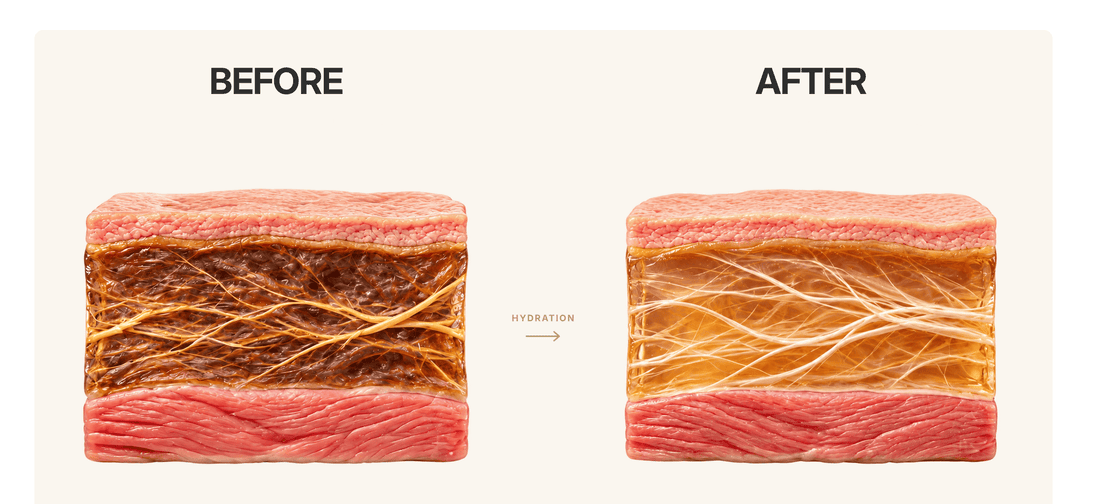
Surgical & Radiologic Anatomy: Hyaluronan Densification in Fascia
"Fascial densification caused by self-aggregation of hyaluronic acid increases connective tissue viscosity by over 500%, generating mechanical immobility, microvascular resistance, and persistent myofascial pain."
View the Published Study on PMC (PMC3108396) →The Missing Cellular Firefighter: Palmitoylethanolamide (PEA)
Under normal conditions, your body produces its own biological "off switch" for connective tissue pain: an endogenous bioactive lipid called Palmitoylethanolamide (PEA).
PEA binds to nuclear PPAR-alpha receptors, commanding hyperactive mast cells to stop spraying histamines and neutralizing the acidic pain peptides documented by the NIH.
In chronic Myofascial Pain Syndrome, your endogenous PEA stores are completely exhausted.
Your natural cellular cleanup crew has shut down. The fascial glue remains sticky, the toxic soup keeps burning, and the knot never gets a single moment of peace.
Pain Physician Meta-Analysis: PEA in Chronic Musculoskeletal Pain
"Double-blind randomized controlled trials demonstrate that Palmitoylethanolamide (PEA) significantly reduces chronic musculoskeletal pain and inflammatory scores by downregulating mast cell degranulation via PPAR-alpha signaling."
Read the Meta-Analysis on PubMed Central (PMC10053226) →The Breakthrough: Systemic Fascial Rehydration from Within
You cannot fix a biochemical energy crisis from the outside with needles, foam rollers, or massage guns.
That is why a team of connective tissue biochemists and orthopedic specialists at FasciaLabs® created the world's first multi-pathway clinical formula engineered to rehydrate the fascial matrix, neutralize the toxic soup, and restore cellular ATP from the inside out:
Fascia Release®.

Myofascial Pain Syndrome: The Fascial Connection
This report looks at the relationship between fascia, hydration, and persistent trigger points in Myofascial Pain Syndrome.
A closer look at stubborn knots in the upper back, neck, and shoulders.

412 clinician recommendations
Reported across the FasciaLabs community, including neurologists and physical therapists.
Explore the formulaThe clinician recommendation count is a brand-wide figure reported by FasciaLabs, not evidence of clinical outcomes for Myofascial Pain Syndrome.
The 9-Component Bio-Active Matrix: Precision Engineering for Trigger Points
1. Micronized Palmitoylethanolamide (PEA) — 600 mg
Activates nuclear PPAR-alpha receptors to halt mast cell degranulation inside the fascial matrix. Directly suppresses Substance P and CGRP, neutralizing the NIH "Toxic Soup" and breaking the cycle of peripheral sensitization.
2. Pure Hyaluronic Acid (Sodium Hyaluronate) — 200 mg
Reverses Stecco hyaluronan densification. Reduces tissue viscosity by up to 500%, transforming rigid fascial glue back into frictionless liquid silk so investing sheets glide effortlessly over muscle fibers.
3. Coenzyme Q10 (CoQ10 / Ubiquinone) — 150 mg
Directly resolves Simons' Energy Crisis. Fuels mitochondrial ATP synthesis inside hypoxic muscle fibers, providing the cellular energy required to pump calcium out and unlock frozen actin-myosin contractures.
4. Bamboo Extract (70% Organic Silica) — 100 mg
Supplies bio-available elemental silicon to stimulate synthesis of supple Type I and Type III collagen, restoring the elastic "crimp" to damaged, rigid fascial sheaths.
5. Boswellia Serrata Extract (65% Boswellic Acids) — 100 mg
Potent selective inhibitor of 5-Lipoxygenase (5-LOX). Halts inflammatory leukotrienes that cause localized fascial thickening and compress microcapillaries.
6. Vitamin C (Ascorbic Acid) — 100 mg
Mandatory cofactor for prolyl hydroxylase, enabling proper collagen triple-helix assembly while scavenging free radicals in hypoxic trigger points.
7. Vitamin D3 (Cholecalciferol) — 50 mcg (2,000 IU)
Regulates calcium channel signaling at the motor endplate, preventing abnormal acetylcholine leakage and blunting involuntary muscle twitching.
8. Zinc Bisglycinate — 10 mg
Activates Matrix Metalloproteinases (MMPs)—the biological enzymes that dissolve tangled, fibrotic collagen adhesions inside chronic taut bands.
9. Manganese Bisglycinate — 2 mg
Mandatory trace mineral cofactor for glycosyltransferase enzymes, driving the regeneration of proteoglycans that hold hydration inside fascial tissue.
The 30 to 90-Day Fascial Remodeling Protocol
The Toxic Soup Neutralizes
Micronized PEA saturates the tissue, halting mast cell degranulation. Substance P and CGRP levels drop. The burning, hot ache between your shoulder blades cools down significantly.
ATP Restores & Capillaries Open
Oral Hyaluronic Acid reduces fascial viscosity by 500%. Microcapillaries re-open, flooding ischemic tissue with oxygen. CoQ10 restores cellular ATP, allowing frozen sarcomeres to unbind naturally without needles or bruising.
Full Connective Tissue Remodeling
Rigid rawhide adhesions are dissolved by zinc-activated MMPs and replaced with supple Type I/III collagen. Taut bands disappear. You sit, drive, and work completely free of burning knots.


